
Karats
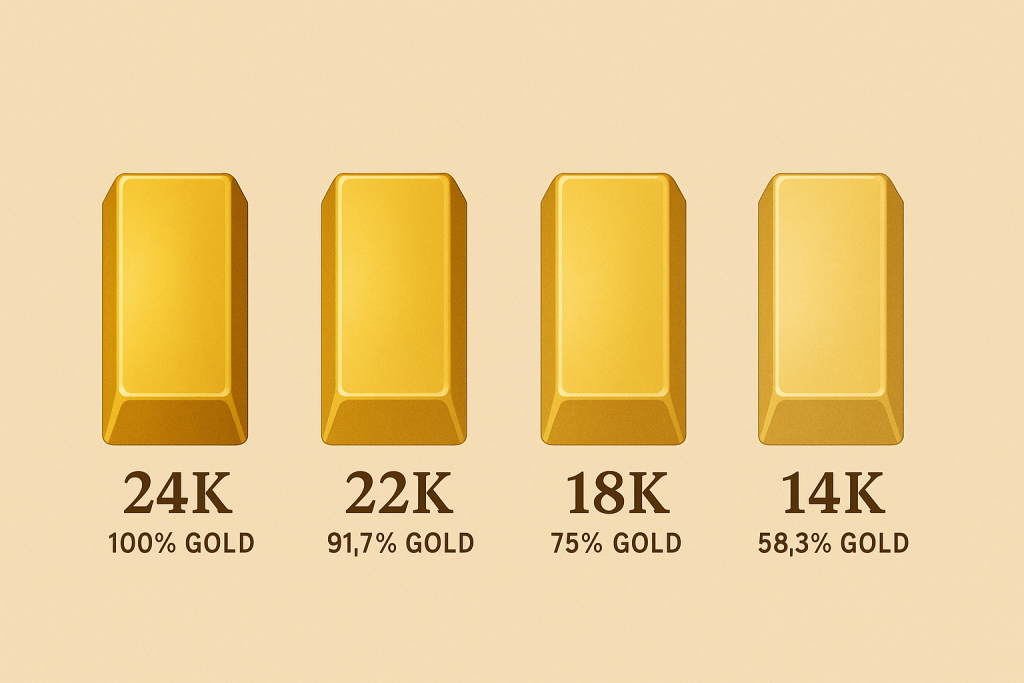
The term “Karat” is abbreviated as “k or kt” is used to measure the purity of gold. Pure gold is considered as 24k (karat) which is free from all types of impurities and other metals. The karat system expresses how many parts of gold are present in 24 parts of the total metal.
- 24 Karat (24K) : 100% pure gold without any impurities.
- 22 karat (22k) : 22 parts of gold and two parts of other metals (91.7% pure)
- 21 karat (21K) : 21 parts of gold and three parts of other metals (87.5% pure)
- 18 karat (18k) : 18 part of gold and 6 parts of other metal (75% pure)
- 14 karat (14k) : 14 parts of gold and 10 parts of other metal (58.3% pure)
- 10 karat (10k) : 10 parts of gold and 14 parts of other metal (41.7% pure)
The karat system expresses how many parts of gold are present in 24 parts of the total metal. Karat (kt) is the standard unit used to express the purity of gold alloys. Pure gold is designated as 24k, indicating 99.9% purity. Gold of less purity values is alloyed with other metals such as silver, copper, or nickel to enhance strength and durability. For example, 18K gold contains 75% pure gold, while 14K gold consists of 58.3% pure gold. The karat rating directly influences the metal’s color, hardness, and market value, making it a critical factor in jewelry manufacturing and investment.
Gold rates of different karats:
| Gold Rate | 24K Gold | 22K Gold | 21K Gold | 18K Gold |
| 1 Tola Rate | 451,000.00 | 413,416.00 | 394,625.00 | 338,250.00 |
| 10 Gram Rate | 386,670.00 | 354,447.00 | 338,336.00 | 290,002.00 |
| 1 Gram Rate | 38,667.00 | 35,444.00 | 33,833.00 | 29,000.00 |
| 1 Ounce Rate | 1,095,930.00 | 1,004,602.00 | 958,938.00 | 821,947.00 |
Importance of karat in different fields:
- Jewellery and Fashion
- Investment and monetary system
- Electronics and technology
- Medical uses
- Culture and religious significance
- Durability vs. Purity: Higher purity gold (such as 22K or 24K) is more precious and gives a rich yellow color. However, it’s softer and can be more prone to scratching or bending. Lower purity gold, such as 14K or 18K, is mixed with stronger alloys like copper or silver to make it more durable for everyday use, while still maintaining a reasonable level of gold content.
- Cultural Preferences: Different cultures value different purity ratings. For instance, 22K gold is highly preferred in many Asian markets, while Western markets often favor 14K and 18K gold.
- Cost Consideration: Gold with less impurities and less alloy mixture is more expensive than the jewelry with high impurities. Consumers often choose gold jewelry based on a balance between budget and desired purity. If you want to know more about the gold and it’s units you can visit other pages.
2. Investment and monetary system:
- Gold Bars and Coins: Gold used in bars and coins is typically measured in troy ounces, but the karat system still applies. Investment-grade gold typically uses 24K gold, as investors seek the highest purity.
- Value: The purity of gold plays a critical role in determining its value. For example, 24K gold would be worth more than 18K gold, and investors looking to buy gold for storage or trading often prefer 24K.
- Economic Factors: Gold with a high karat value is often considered a “safe-haven” investment in times of economic uncertainty. Investors need to understand purity when making decisions about buying or selling gold.
3. Electronics and Technology:
- Conductivity and durability: pure gold is a good conductor of electricity, that is why it is used in high-end electronics such as switches, connectors and circuitry. Pure gold is so soft thats why it is not directly used and it is alloyed with some metal to provide extra strength to maintain conductivity.
- Cost Efficiency: Using pure gold in electronics increases its price and that is the reason the gold used in electronics is alloyed to maintain the conductivity as well as the price. Therefore, alloys with lower karat values, such as 18K or 14K, are used, balancing cost with performance needs
4. Medical uses:
- Biocompatibility: Gold is used in medical devices, dental work (such as crowns), and certain treatments because of its biocompatibility meaning it’s less likely to cause allergic reactions. Gold used in medical applications is typically of a high quality, though alloys are also used to enhance strength and durability.
- Dental restorations: 22K or 18K gold is commonly used for dental crowns and fillings due to its resistance to corrosion and ability to bond well with teeth.
5. Cultural and religious significance:
- Symbolism of Purity: In many cultures, gold is seen as a symbol of wealth, purity, and divine power. Higher quality gold is often used in religious artifacts, wedding rings, or ceremonial items. The purity of the gold in these items reflects its spiritual significance. It is most commonly used on marriages, birthdays and many other special occasions.
- celebrations: Gold with a higher quality is often used for gifting during important events such as weddings or anniversaries, where gold represents permanence and the value of the relationship. It is also used for gifting.
Karat (kt) is the standard unit used to express the purity of gold alloys. Pure gold is designated as 24k , indicating 99.9% purity. Gold of lesser karat values is alloyed with other metals such as silver, copper, or nickel to enhance strength and durability. For example, 18K gold contains 75% pure gold, while 14K gold consists of 58.3% pure gold. The karat rating directly influences the metal’s color, hardness, and market value, making it a critical factor in jewelry manufacturing and investment. Check this for more information about karats.